
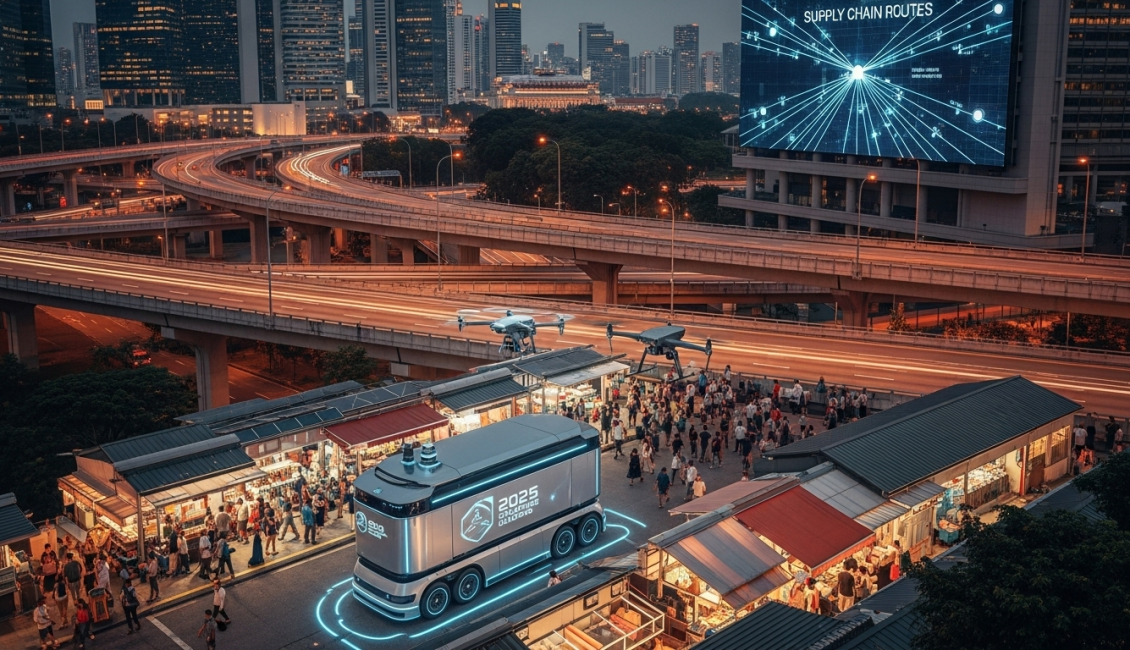
The 2025 e-commerce inflection point in Singapore
Singapore’s e-commerce market continues to accelerate. Rising consumer expectations for same-day and scheduled delivery, tighter urban geographies, and sustainability targets have pushed retailers and logistics providers to rethink how goods move from sellers to buyers. For SMEs and large brands alike, adopting modern singapore supply chain solutions and focused singapore point to point logistics is no longer optional — it’s a competitive necessity.
This article outlines how AI-powered last-mile strategies and operational models are transforming delivery economics and customer experience across the island-state.
Why Singapore needs AI-driven last-mile and point-to-point models
Singapore’s dense population and limited land create unique logistics dynamics. Short distances mean fulfillment centers can be smaller and closer to demand, but expectations for speed and transparency remain high. Key pressures include:
- Peak-hour congestion and high delivery windows that require precise routing
- Rising labour costs and skilled worker shortages
- Sustainability and regulatory nudges toward electrification
- Cross-border demand from regional shoppers
AI-driven tools — from predictive ETAs to dynamic routing and demand forecasting — address these pressures by squeezing inefficiencies out of last-mile operations and enabling direct, point-to-point movement of parcels where appropriate.
AI-powered last-mile strategies that work in Singapore
AI is no longer experimental: it is embedded in routing engines, customer communications, and yard operations. Practical last-mile applications include:
- Route optimization with real-time traffic and delivery constraints to reduce idle time and fuel use
- Predictive ETAs and exception detection, improving first-time delivery rates and reducing customer inquiries
- Dynamic allocation of tasks across delivery modes: couriers, e-bikes, lockers, and autonomous shuttles
- Demand forecasting that drives micro-fulfillment decisions and inventory placement
Linking these capabilities to modern platforms lets businesses scale without proportional cost increases. For integrated warehouse-to-door operations, consider working with partners offering robust warehousing solutions and smart automation.
Point-to-point logistics: a fit for Singapore’s urban fabric
Point-to-point logistics means moving goods directly between two nodes without multiple handoffs. In Singapore, that can translate to:
- Dark stores and micro-fulfillment centers that serve immediate neighbourhoods
- Direct courier lanes between high-volume sellers and customer clusters
- On-demand parcel shuttles between a central hub and satellite pick-up points
This model reduces handling, shortens delivery time, and lowers damage risk. It also pairs well with advanced routing and dispatch systems. To streamline execution, many retailers couple point-to-point flows with full-service fulfillment services that handle picking, packing, and last-mile orchestration.
Technology stack: what to invest in now
Adopting AI-driven last-mile systems requires the right technology stack and integration discipline:
- Transportation Management System (TMS) with AI routing
- Warehouse Management System (WMS) that supports real-time inventory shifting
- Order Management System (OMS) to orchestrate multi-channel demand
- Customer-facing tracking with predictive ETAs and messaging
- Telematics, e-bike telemetry, and route telemetry for performance analytics
APIs and modular integrations allow businesses to pilot specific capabilities, such as dynamic rerouting or customer re-scheduling, without a full rip-and-replace. For end-to-end visibility and faster onboarding, explore providers that also offer inventory management integrations.
Sustainable practices that also save money
Sustainability is a high-priority trend in Singapore logistics. Electrifying last-mile fleets, increasing consolidation, and optimizing parcel routing reduce emissions and often lower costs in the medium term. Actions to consider:
- Shift high-volume short routes to e-bikes and EV vans
- Use parcel consolidation zones to reduce failed deliveries
- Implement reusable or compact packaging to increase van density
Many last-mile operators in Singapore design these green practices into their service level agreements; review options for low-emission delivery windows when choosing a partner.
Practical playbook: implementing AI-powered last-mile operations
- Start with data: collect historical order patterns, delivery exceptions, and customer windows. Clean data drives better AI outcomes.
- Segment SKUs and customers: identify which items need hyper-fast delivery versus those suitable for standard fulfillment.
- Pilot micro-fulfillment near high-demand clusters to test point-to-point flows and reduce lead times.
- Deploy predictive ETA and messaging to reduce failed attempts and customer uncertainty.
- Mix modalities: integrate e-bikes, lockers, and scheduled courier windows for cost control.
- Measure outcomes: track on-time delivery, cost per delivery, first-time success, and CO2 per parcel.
- Iterate: refine AI models with live performance data and scale successful pilots.
During the pilot and scale phases, partner selection matters. Look for providers that offer both tech and operational depth — for example, those providing comprehensive last-mile delivery support and SLA-driven performance.
Cross-border and regional considerations
Singapore is a regional hub. As cross-border e-commerce rebounds, smart singapore supply chain solutions must include customs-aware route planning, harmonized returns, and cost-effective transport lanes. Consolidation and pre-clearance options reduce dwell times at borders, and connecting these capabilities to a reliable domestic last-mile partner closes the customer promise.
If your business ships to or from the region, evaluate partners that can blend domestic agility with regional cross-border logistics capabilities.
KPIs to measure success
Track a compact set of KPIs to quantify the benefit of AI and point-to-point strategies:
- Delivery cost per parcel
- On-time delivery rate and first-time success rate
- Average delivery lead time (order-to-door)
- Customer satisfaction (NPS or CSAT for delivery)
- CO2 emissions per parcel
Combine these with operational monitoring — idle time per driver, time in vehicle, fulfillment cycle times — to identify further optimization opportunities.
A short Singapore case example
A mid-sized fashion retailer in Singapore adopted micro-fulfillment near three dense neighborhoods, introduced AI routing for its fleet of e-bikes, and provided real-time ETAs to customers. Over six months they saw a 25% reduction in delivery cost per parcel, a 40% improvement in first-time delivery success, and a measurable decline in average delivery time. The retailer also shifted a portion of same-day orders into direct point-to-point lanes, improving margin on premium deliveries.
This illustrates the compounding gains from combining singapore supply chain solutions with targeted singapore point to point logistics and AI orchestration.
Final thoughts: practical momentum for 2025
Singapore’s compact geography and high digital adoption make it an ideal proving ground for AI-powered last-mile strategies and point-to-point logistics. Businesses that combine smarter inventory placement, modular technology, and green fleet investments will reduce cost, improve service, and meet regulatory and consumer expectations.
To make progress this year, prioritize data quality, pilot local micro-fulfillment, and select partners that can execute both operationally and technologically. The right mix of AI and efficient point-to-point flows will be a decisive advantage for e-commerce growth across Singapore.